- New epoxy resin technology combines fire protection, lightweight construction, and circular economy
- The aviation, transportation, and composites industries are seeking sustainable solutions and recyclable materials
- Test results show that high fire safety requirements and recyclability are not mutually exclusive
Wesel / Büsserach (Switzerland) - September 01, 2026 – Airplanes and passenger trains must meet strict safety requirements, including those for fire protection. This calls for materials that are flame-retardant, lightweight, robust, and scalable. Researchers at Empa, the Swiss Federal Laboratories for Materials Testing and Research, have developed the first fully recyclable composite material. The project was conducted in collaboration with ELANTAS, a division of the specialty chemicals group ALTANA, serving as the industry partner. It was supported by Innosuisse, the Swiss Agency for Innovation Promotion.
“If a fire breaks out in an aircraft, the materials used must provide reliable protection,” says Fiorenzo Lenzi, Head of the Aerospace/Ballistic Product Line at ELANTAS. In recent fire tests with the novel composite material, while flames do burn, the material itself does not ignite. This is made possible by an innovative epoxy resin technology that experts from ELANTAS at the Büsserach site near Basel are testing together with researchers from Empa in St. Gallen for future applications in aviation and rail transport.
Lightweight, high strength, and excellent fire protection
Aircraft floors, side walls, and other structural components are often made today from high-performance composites based on epoxy resins and glass or carbon fibers. These materials offer the advantages of low weight, high stability, and excellent fire protection properties. “Bringing all these properties together under one roof is a challenge,” explains Empa researcher Sabyasachi Gaan from the “Advanced Fibers” laboratory. “For example, when you make a material flame-retardant, you always end up altering its other properties as well.”
After use, these components are usually incinerated or landfilled. Every year, this results in millions of metric tons of non-recyclable composite waste worldwide. However, the European Union has set ambitious goals for a more circular economy and aims to achieve significantly higher recycling rates for plastic waste by 2030.
New epoxy resin as the basis for the next generation of composite materials
Together with Empa, ELANTAS is therefore investigating a novel epoxy resin intended to serve as the basis for the next generation of flame retardant composites. The material developed by Empa contains phosphorus, which fulfills two important functions: It acts as a highly efficient flame retardant while also enabling the subsequent recycling of the resin.
The unique mechanism works as follows: A suitable solvent can specifically bind to the phosphorus-containing structures in the resin. This allows the cured composite material to be dissolved again and broken down into its constituent parts. Valuable materials such as glass fibers, carbon fibers, or honeycomb structures can be recovered and reused. This technology thus opens up a completely new approach to the circular economy for high-performance composites.
Real Market Potential for Multiple Industrial Sectors
“As a leading manufacturer of insulation and protective materials as well as solutions for composites, ELANTAS sees real market potential for this new development,” says Lenzi. “Customers in the aerospace, transportation, and composites industries are increasingly asking for sustainable solutions and recyclable materials.” ELANTAS is contributing its many years of experience with epoxy resin systems and high-performance composites to the project and is guiding the development with an eye toward future industrial applications.
“For the aerospace industry, it is crucial to combine fire protection, lightweight construction, and recyclability. This epoxy composite system demonstrates that this is possible for the first time,” says Lenzi.
Although several more years of development work and further scaling steps will be required before the product is ready for the market, the test results to date show that high fire safety requirements and recyclability are no longer mutually exclusive.
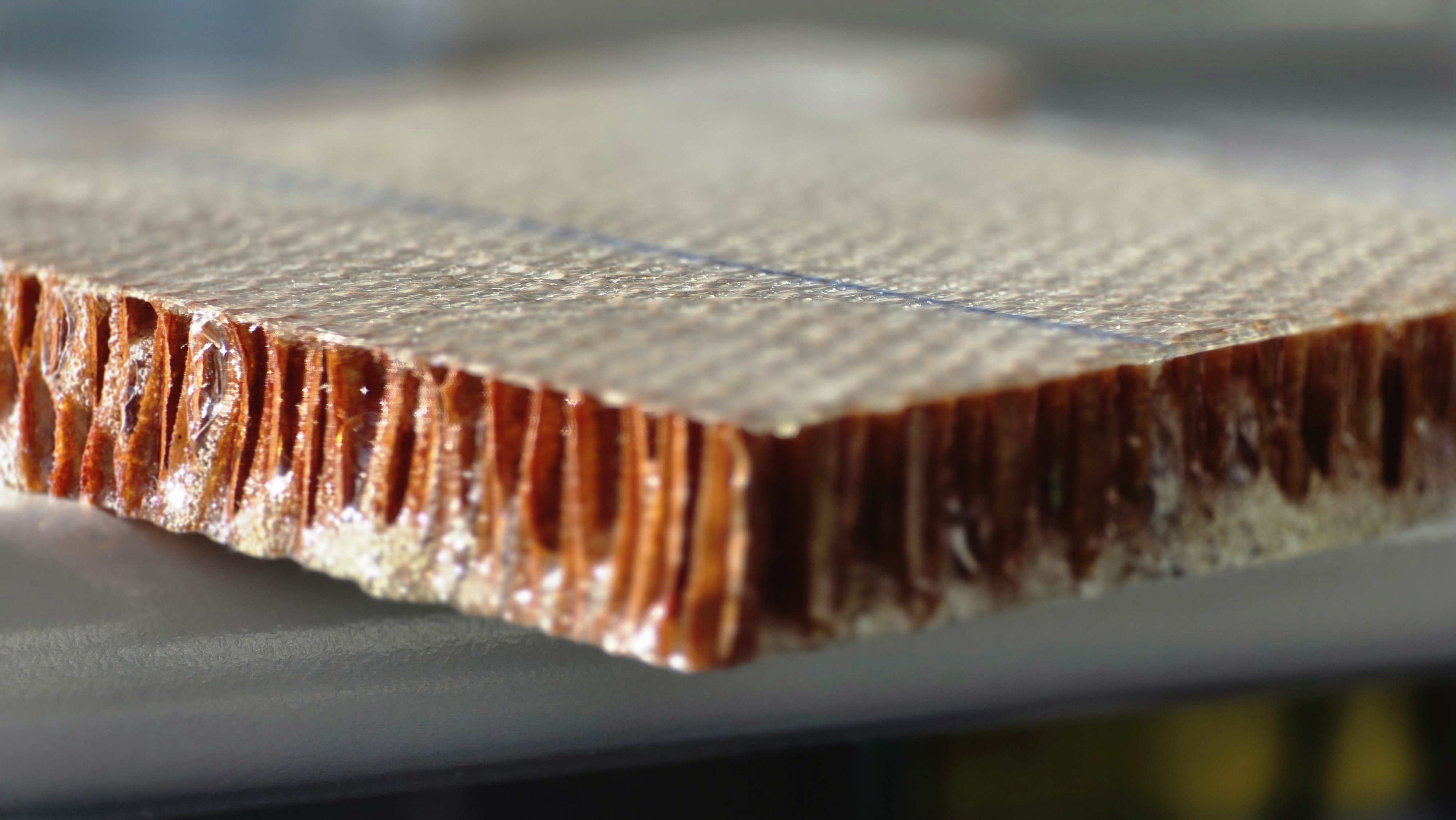
The composite material made of epoxy and glass fibers not only protects against flames but is also fully recyclable. Image: Empa
About ELANTAS:
ELANTAS, as part of the ALTANA Group, is a leading global supplier of innovative insulation and protection materials. The company has a global footprint in all major regions worldwide and employs more than 2,000 people.
Solutions of ELANTAS significantly support the transformation to electromobility, the expansion of renewable energies, and the development of high-performance data centers for artificial intelligence applications.
The extensive product portfolio includes enamels and tapes for insulating metal wires, as well as materials for the electrical, mechanical, and chemical protection of electrical and electronic components. The range is complemented by solutions for printed electronics and specialized applications in toolmaking. The products are used in key components such as electric motors, generators, transformers, and capacitors, where they contribute to safety, efficiency, and longevity.
The company is headquartered in Wesel, Germany.
About Empa:
Empa is the ETH Domain’s interdisciplinary research institute for materials science and technology. Serving as a bridge between research and practical application, it develops innovative solutions to the most pressing challenges facing industry and society. Through efficient technology transfer in close collaboration with industry partners, Empa fosters innovations that strengthen both the innovative capacity and the international competitiveness of its industry partners. A careful use of our natural resources and thinking in closed cycles are core to Empa's approach
About ALTANA:
ALTANA is a global leader in true specialty chemicals. The Group offers innovative solutions for coating manufacturers, paint and plastics processors, the printing and packaging industries, the cosmetics sector, and the electrical and electronics industry. The product range includes additives, specialty coatings and adhesives, effect pigments, sealants and compounds, impregnating resins and varnishes, and testing and measuring instruments. ALTANA’s four divisions, BYK, ECKART, ELANTAS, and ACTEGA, all occupy a leading position in their target markets with respect to quality, product solution expertise, innovation, and service.
Headquartered in Wesel, Germany, the ALTANA Group has 58 production facilities and 67 service and research laboratories worldwide. Throughout the Group, more than 8,000 people work to ensure the worldwide success of ALTANA. In 2025, ALTANA achieved sales of more than 3 billion euros. About 7 percent of the total sales is invested in research and development each year. Its high earning power and high growth rate make ALTANA one of the world’s most innovative, fastest growing, and most profitable chemical companies.