Corporate Report 2025: Letter from the Management Board | About This Report | Sustainability Management | Corporate Bodies and Management | Report of the Supervisory Board | #DiscoverGoodChemistry | Group Management Report | Products | Safety and Health | Environment | People | Social Commitment | Consolidated Financial Statements (condensed version) | Multi-Year Overview | Global Compact: Communication on Progress (COP) | ALTANA worldwide | List of Shareholdings | Contact
Organization and Legal Structure
The ALTANA Group is a global supplier of specialized chemical products and related services for different branches of industry and application fields. In the 2025 fiscal year, the Group’s 84 consolidated entities achieved sales of around € 3.1 billion. The ALTANA Group employs more than 8,000 people.
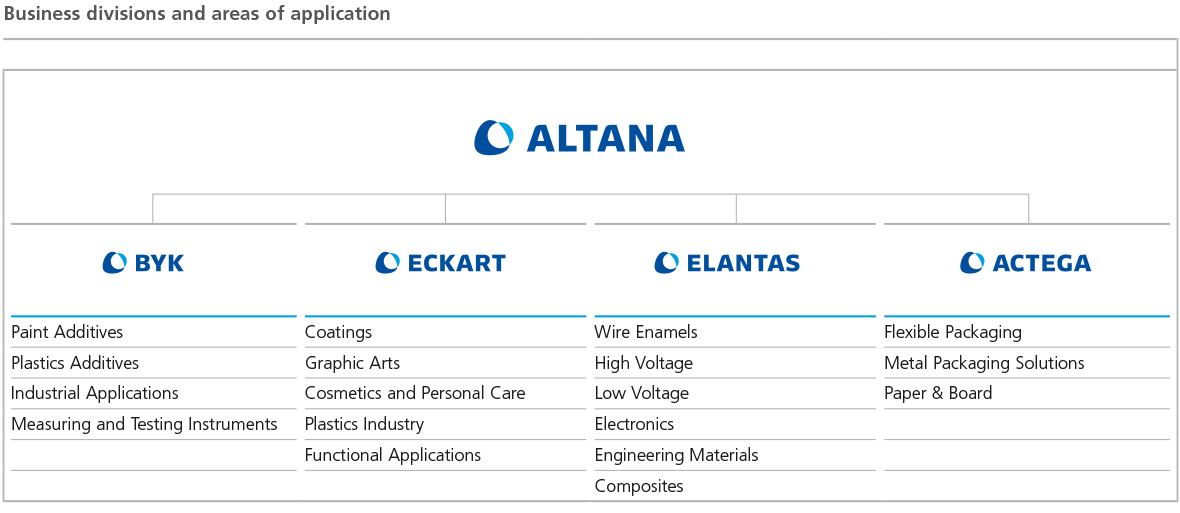
ALTANA’s activities are grouped into four divisions, each of which has its own management and organizational structure. The divisions and the Group companies assigned to them are decentralized and empowered to largely make market-, location-, and product-related decisions themselves. The divisions are active worldwide and have their own production sites and sales offices as well as research and development laboratories in the markets that are important for them. Apart from the four operating divisions, there are holding companies in which Group management activities and internal services are bundled. Furthermore, activities for the cross-divisional development of new business areas are undertaken at this level.
ALTANA AG, headquartered in Wesel, is a stock corporation in accordance with German law. As the ALTANA Group’s managing company, it assumes strategic control of the Group and the divisions. ALTANA AG is led by the Management Board, whose members act on their own responsibility and are solely committed to the interests of the company. The Management Board’s activities are monitored by the Supervisory Board, whose members also advise the Management Board. More information on ALTANA AG ’s management and control system is provided in the Declaration on Corporate Governance in the Group Management Report.
All of the shares in ALTANA AG are held by SKion GmbH, Bad Homburg v. d. H., Germany, an investment company owned by the Klatten family.
The decentralized organizational structure combines the individual operating units’ ability to act swiftly and cater to the needs of markets and customers with the advantages of a financially strong and internationally active group. The organization is designed to adapt flexibly to changed market conditions and a volatile economic environment. In addition, new activities can be integrated into the organization in a short time.
Business Activity and Divisions
As a globally active specialty chemicals group, ALTANA focuses its core activities on sophisticated markets and customers who need individual solutions.
A significant share of the ALTANA Group’s product and service portfolio encompasses additives and pigments for the production of coatings, printing inks, and plastics. In addition, ALTANA manufactures printing inks and coatings for special applications, products for 3D printing, insulating and protective materials and systems for the electrical and electronics industries in the low-voltage and high-voltage range, sealants for packaging, and measuring and testing instruments.
Activities of the Divisions
BYK
The BYK division is one of the leading international suppliers of special-purpose ingredients, so-called additives, used in coatings and paints, plastics, and other industrial applications. The division’s products, most of which are used in only very small amounts, have a decisive influence on the properties of their customers’ end products or enable customers to improve their manufacturing and industrial processes.
Wetting and dispersing additives, one of the division’s main product groups, help improve the even distribution of pigments and filling materials, and enable them to function better, for example in coatings and plastics. With the help of defoamers and air-release additives, foaming is prevented during the manufacture of coatings and paints as well as in end customers’ applications. Surface additives are used to produce special properties such as shiny, matte, or especially smooth surfaces. Rheology additives improve the flow behavior of coatings and plastics. The division also manufactures measuring and testing instruments that are used to determine surface properties, color shades, layer thicknesses, and optical effects and are utilized, among other areas, in the semiconductor industry.
BYK-Chemie GmbH, based in Wesel, is the management company of the division. In addition, it is the division’s biggest production and development site for additives and the ALTANA Group company with the highest sales. BYK also produces at other sites in Germany, the Netherlands, Great Britain, as well as in the U.S. and China. The measuring and testing instruments are manufactured at a site in southern Germany (Geretsried), and also partly in Columbia, Maryland, and Fairport, New York (both in the United States).
The division sells its products primarily under the brands BYK (additives) and BYK-Gardner (instruments). Due to its comprehensive portfolio, BYK is a system supplier and partner of coatings manufacturers and plastics processors in particular. On the basis of its great problem-solving expertise, BYK has also attained an important market position in many other industrial application fields in recent years.
The division markets its products in the important regions via its own companies and branches. In addition, a dense network of dealers and agents markets its products worldwide. BYK generates the highest share of its sales in Asia, followed by Europe and the Americas. In terms of countries, the U.S. makes the largest contribution to sales, followed by China and Germany.
BYK continually expands and supplements its product portfolio. To gear its innovation activities closely to the needs of the markets, the division has its own network of development laboratories, which cooperate closely with customers in the respective regions. At the same time, new fields of application are continually tapped for existing or new products.
ECKART
ALTANA concentrates the development, production, and sale of metal pigments and metal powders in the ECKART division. Customers use these products to achieve visual and functional effects, primarily in coatings, plastics, printing inks, cosmetics, and construction materials. The principal raw materials are aluminum, copper, and zinc. Aside from metallic effect pigments, other pigments are offered based on synthetic minerals. The division’s portfolio is supplemented by effect printing inks, metal powders for 3D printing, as well as the corresponding services.
Aluminum-based effect pigments comprise the largest part of ECKART’s business. Customers use them particularly to achieve silver metallic effects, for example, for car paints or on graphic arts products. Aluminum pigments are also used for functional purposes, for example, in the manufacture of aerated concrete. Copper-based bronze effect pigments generate golden effects in paints, printing inks, and plastic products. Customers use zinc pigments in special paints to achieve functional properties, particularly for corrosion protection.
ECKART GmbH is the division’s operating management company. Operational control of its business activities is organized by the regionally structured areas: the Americas, Asia, and Europe. Major production sites are located in Southern Germany (Hartenstein and Wackersdorf), producing a significant share of the effect pigments sold worldwide. Additional production sites are in eastern Germany (Bitterfeld), Switzerland, Finland, the United Kingdom, the U.S., and China.
The manufacturing process is characterized by a high degree of value creation. In a number of successive steps, all kinds of pigments are made, refined chemically, and in some cases processed into press-ready printing inks.
The effect pigments are marketed predominantly via the division’s own sales structures, but also by sales partners. ECKART’s most important customers include international manufacturers of coatings, printing inks, and plastics. Other important customers are manufacturers in the construction industry, the metal-based 3D printing industry, and the cosmetics sector. ECKART achieves around half of its sales in Europe. Its next largest sales regions are Asia and the Americas.
As an important manufacturer of metal effect pigments, ECKART continually pushes forward the development of new product qualities and opens up new fields of application on the basis of sophisticated technological expertise and many years of knowhow. ECKART’s product portfolio is continually improved in order to offer its customers further and even better high-performance materials.
ELANTAS
The ELANTAS division offers its customers in the electrical and electronics industries extensive expertise in the field of protective and insulating materials. As one of the world’s leading suppliers, the division focuses on a product portfolio that includes coatings and tapes for insulating metal wires as well as materials for the electrical, mechanical, and chemical protection of electrical and electronic components. These include wire enamels, high-voltage tapes, impregnating resins, potting materials, and insulation papers. Such materials are indispensable for manufacturers of magnet wires made of copper or aluminum as well as for producers of electrical and electronic components.
ELANTAS operates under the management of ELANTAS GmbH, based in Wesel. This holding company controls the division’s activities and supports its operating subsidiaries, which develop and produce insulating materials in Italy, Germany, France, Switzerland, China, India, Malaysia, the U.S., and Brazil. With 19 production sites worldwide, ELANTAS ensures security of supply and high-quality standards on a global level. Asia – particularly China – remains the division’s largest sales market, reflecting the concentration of electrical and electronics manufacturing in this region. Other important markets are the U.S., India, Italy, and Germany.
Thanks to its comprehensive expertise in the manufacture and application of insulating systems, the ELANTAS division continues to expand its activities. Both the development of new insulating materials and the application of specific knowledge in polymer chemistry are intended to open up new fields of application and growth potential. Global trends such as increasing electromobility, the expansion of renewable energies, and the growing spread of data centers offer additional growth opportunities. The increased use of electronic components in everyday life also contributes to further strengthening the company’s market position. These trends reinforce ELANTAS’ position as a reliable partner for high-performance insulation solutions.
ACTEGA
The ACTEGA division’s portfolio is tailored to the needs of the packaging and graphic arts industries. It produces specialty coatings, printing inks, adhesives, and sealants used by customers to achieve functional and visual effects.
In 2025, three German operating companies were merged into the former parent company, ACTEGA GmbH, headquartered in Wesel. This realignment of the organizational structure optimizes the management structure regarding functionally and globally oriented organizational units. In research and development, activities are bundled in four technology groups and one competence center. The division’s business activities are divided into three business lines: Flexible Packaging, Metal Packaging Solutions, and Paper & Board. The products are distributed and manufactured by subsidiaries in Germany, Switzerland, France, Spain, the U.S., Canada, Brazil, Chile, China, India, and Thailand.
Important product groups of the division include coatings and printing inks, as well as sealants and adhesives used to make packaging materials. A focal point of its product portfolio is the specific needs of the food industry with its high-quality requirements. In addition, there is demand for ACTEGA’s printing inks and overprint varnishes among customers in the graphic arts industry. The division’s largest sales region is Europe, followed by the Americas. Its most important individual markets are the U.S. and Germany.
Together with the packaging industry and in direct contact with brand manufacturers, ACTEGA develops new and improved optical and haptic functionalities. Its innovation activities primarily aim to optimize the safety and shelf life of packaged foods.
In recent years, the division has invested in a targeted way in the acquisition and further development of existing and new technologies to tap new growth potential for its business in the medium to long term and thus further expand its market position in label printing with the ECOLEAF and Signite® decoration solutions, for example. Both technologies underline the ambition to offer customers more sustainable solutions.
Important Influences on Business Development
ALTANA’s different sales markets are influenced by various short-, medium-, and long-term trends.
In the course of a year, seasonal fluctuations in demand result from lower customer activity, for example during the Chinese New Year Festival, during the summer holiday season, and at the end of the year.
Short- and medium-term fluctuations in demand result mainly from economic developments. The current development of consumer behavior is not the only factor. Our customers’ expectations regarding the short-term development of the end markets downstream in the value chain also have a significant impact on their purchase behavior. This appraisal largely determines how much storage is reserved.
In addition, actual and expected changes in the prices of essential raw materials impact the sales situation. When raw-material prices continually rise, customers look for alternative input materials, and this influences overall sales or the product mix. The same applies to significant changes in other cost components that have a strong influence on the price of products. This price sensitivity of the markets is also reflected in short-term changes in demand, when for example stronger price fluctuations are expected for significant raw-materials markets.
The competitive situation in the different product-specific market segments can have similar effects on customer behavior. The entry of new manufacturers into a market or the withdrawal of existing manufacturers from a market and the competitors’ prices can impact demand.
Long-term changes in demand for the Group’s products and services are brought about on the one hand by global megatrends and the economic growth of certain regions. On the other hand, product and technological developments continually open up new sales potential or lead to product segments being discontinued.
Strategy and Control System
Strategy
Current market requirements, and market demands expected for the future, determine the ALTANA Group’s corporate action. The success of our customers is at the center of our business activities. We can only be successful in the competitive environment in the long run if we offer our customers added value.
ALTANA’s strategy is consistently geared toward sustainable profitable growth in future-oriented specialty chemicals markets. Our top financial priority is to sustainably increase the company’s value.
Profitable growth at ALTANA is based on four aspects: The first is the operational expansion of activities in existing markets and the development of new adjacent sales segments. ALTANA’s four divisions occupy significant competitive positions in their respective sales markets. This positioning is an important prerequisite for being identified and acknowledged by market participants as a competent provider of customized solutions.
In addition to ALTANA’s comprehensive product portfolio, innovation plays a key role in its high level of problem-solving expertise.
To enable customers to create new applications and strengthen their portfolio, ALTANA continually pushes forward its own research and development activities, particularly in the area of sustainability. To this end, our employees’ know-how and experience are just as important as investments in new technologies.
ALTANA is actively engaged in the strategic alignment of its business operations with sustainable practices. This encompasses initiatives such as the defossilization of ALTANA and its supply chains, including logistics, but also the transformation of ALTANA’s product portfolio toward sustainable materials that enable a circular economy.
Furthermore, we consistently enhance our operational growth by acquiring new companies or business activities, ensuring a continuous expansion of our specialized service portfolio. This strategic approach allows us to integrate new segments of the value chain into the Group or provide access to novel markets and technologies.
Control System and Goals
ALTANA’s control system is fundamentally oriented to the goal of sustainable profitable growth. A number of key performance indicators are derived whose developments are analyzed and for which target values are determined. The most important key performance indicators are sales growth, earnings before interest, taxes, depreciation and amortization (EBITDA), the EBITDA margin as well as the investment level, both in relation to sales, and the return on capital employed (ROCE) with the resulting ALTANA Value Added (AVA).
ROCE is derived from earnings before interest and taxes (EBIT), adjusted for one-time special effects, such as integration expenses incurred in connection with acquisitions or significant insurance reimbursements, and reduced by a calculated tax burden.
The capital employed, in turn, encompasses those components of the assets and liabilities needed to achieve operating earnings. Derived from ROCE, we also calculate ALTANA Value Added, which takes into account the cost of capital employed. The cost of capital is determined from the weighted average of cost of debt and cost of equity. We regularly examine the weighted average cost of capital but only adjust it for the calculation of the AVA if it exceeds or falls below a certain range. For 2025, the cost of capital rate remained at 7.5 %. No adjustment is planned for 2026.
Key performance indicators for value development are used both to measure performance and as criteria for strategic and operational decisions at different levels of the Group. The AVA indicator is also used to determine variable components of compensation.
Our goal is to achieve operating earnings that exceed the cost of capital on a sustainable basis. We achieved this goal of generating a positive AVA again in the reporting year, as in the previous year.
Sustainable profitable sales growth forms the basis for a long-term increase in our operating earnings and thus in the value of the company. ALTANA’s goal is to outperform the general market growth in the most important sales segments and thus to obtain market shares.
In the long term, we aim to achieve average annual operating sales growth of 5 %. We seek to generate additional growth through acquisitions, either by acquiring supplementary activities at the level of our existing divisions or through the possible integration of new business activities.
However, growth must not come at the expense of profitability. Within the ALTANA Group, the management of the EBITDA margin is therefore of high importance. The long-term target range for the Group’s EBITDA margin is 18 % to 20 %. Based on this, long-term target margins have been defined for the four divisions, which may deviate from the Group’s average target value due to their different business activities and market characteristics. Over many years, the Group’s achieved margins were within or, in some individual years, even above the target range. Since 2022, EBITDA margins have been below the target range due to inflation-related sales price increases, significant cost increases, and demand declines driven by economic conditions. In the 2025 reporting year, the EBITDA margin still did not reach the strategic target range, in particular due to the continued tense geopolitical and economic environment.
Aside from pursuing long-term sales and earnings growth, another focus to successfully increase the value of the company is control of the operating capital. The main factors of influence in this context are the development of fixed assets and of net working capital.
In research and development, we aim to achieve a cost ratio of 6 % to 7 % of sales in order to safeguard the long-term orientation of our innovation activities.
On average over several years, our investments in property, plant and equipment and intangible assets have been around 5 % to 6 % of our sales. Due to this continuity, sharp increases in operating capital and resulting short-term fluctuations of the ROCE can be minimized. Furthermore, every important investment is examined regarding its short- and long-term effects on the company’s value.
For the control of net working capital, which is of great importance for the development of operating capital, we use key performance indicators to analyze and control profitable growth and the company’s value. These key performance indicators concern the scope of inventories as well as trade accounts receivable and payable.
Apart from the aforementioned essential financial control parameters, there are other financial key indicators that help us analyze and control profitable growth and the company’s value. The most important ones are cost figures (cost of materials, personnel expenses, etc.).
To ensure that all activities are consistently aligned with the Group’s strategy, ALTANA also uses non-financial key performance indicators. Significant control-relevant non-financial indicators, and thus key performance indicators for Group management, relate to occupational safety and environmental performance. To monitor the achievement of the goal of continuously improving occupational safety, ALTANA uses the Work Accident Indicator (WAI) as a key performance indicator for management purposes. The WAI comprises WAI 1, WAI 2, and WAI 3. WAI 1 represents the number of reported occupational accidents resulting in one or more lost workdays per one million hours worked. WAI 2 reflects the number of reported occupational accidents resulting in more than three lost workdays per one million hours worked. WAI 3 indicates the number of lost workdays per one million hours worked, with a maximum of 30 lost workdays per accident taken into account. For the management of greenhouse gas emissions, ALTANA records energy consumption and uses total Scope 1 and Scope 2 emissions (with Scope 2 calculated in accordance with the market-based method) as key performance indicators. In addition, specific energy consumption (energy per metric ton of produced finished goods) is used as a further performance indicator.
Apart from these two groups of indicators, there are other non-financial indicators which are not regarded as being relevant for control. These include data for the evaluation of innovation activities as well as other key performance indicators in the realm of sustainability, for the analysis of sales markets.
Since 2025, WAI 2 and greenhouse gas emissions from Scope 1 and 2 (market-based) have also been integrated into ALTANA’s compensation system.
Integrated Planning Processes
All key performance indicators relevant for control are compiled and analyzed within standardized reporting processes. To use these indicators effectively for steering strategy and short- and medium-term measures, ALTANA employs an integrated planning process that covers multiple planning levels and dimensions.
The planning cycle includes a strategic planning component, which combines the analysis of the essential performance indicators for future business development at the product group level with a detailed representation of expected changes in the market environment.
From this analysis, strategic measures are derived to enable early responses to anticipated developments. These measures, developed during the strategic planning process, encompass not only actions on current sales markets but also concrete goals and planning steps for entering new business fields or application areas, as well as adjustments to the portfolio of business activities.
Decisions made within the framework of strategic planning feed into subsequent medium-term financial planning. This planning outlines growth and profitability targets for the coming three years and assesses the impact of the expected business development on ALTANA’s asset and financing structure, providing a basis for potential measures in the financing strategy. Medium-term financial planning is further enhanced by scenario analyses, which transparently illustrate the sensitivities of key performance indicators to relevant, particularly cyclical, changes in the market environment. From these analyses, ALTANA derives appropriate reaction levels for potential countermeasures.