Corporate Report 2025: Letter from the Management Board | About This Report | Sustainability Management | Corporate Bodies and Management | Report of the Supervisory Board | #DiscoverGoodChemistry | Group Management Report | Products | Safety and Health | Environment | People | Social Commitment | Consolidated Financial Statements (condensed version) | Multi-Year Overview | Global Compact: Communication on Progress (COP) | ALTANA worldwide | List of Shareholdings | Contact

Innovation
As a specialty chemicals company, ALTANA relies on innovation to offer our customers new, competitive solutions that meet current requirements in terms of performance profile, costs, environmental protection, and sustainability. Thanks to close cooperation with our customers, we are able to identify global technology trends at an early stage and become involved in new areas of development without delay. This enables us to develop customized solutions quickly and reliably. We build on our existing competencies while at the same time acquiring new capabilities to continuously adapt our product portfolio to changing market and customer needs. There is also considerable potential in combining expertise across business divisions in order to bring innovative solutions to market more quickly and efficiently. Our research and development teams have access to state-of-the-art analytical methods and application testing laboratories. Numerous awards from customers underscore our success as an innovative solutions provider.
Apart from activities within the divisions, selected innovations are initiated and coordinated at ALTANA level with the aim of opening up new business areas and addressing technology and market trends. These activities are based on the strong competencies of our divisions along the entire value chain and on the synergies between them. We use different but complementary approaches to shape new innovation areas: the ALTANA Institute, our technology platforms, Corporate Venturing, and additional innovative growth areas.
With the help of the ALTANA Institute, we leverage external networks and close collaborations with universities and research institutes worldwide in order to gain external impetus for our development activities. We cooperate in the field of basic research on topics that form the foundation for further, more application-oriented internal research and development. Completed projects are transferred to the divisions via structured technology transfer. In 2025, two new projects were launched. The existing strategic partnership with Friedrich Schiller University Jena was expanded through a further project. Furthermore, a project at the interface of artificial intelligence and materials research using large language models (LLMs) was initiated for the first time within the ALTANA Institute, accompanied by a new cooperation with the University of Bayreuth. The existing research collaboration with Graz University of Technology in Austria was further intensified.
Within the “Cubic Ink” technology platform, the relevant product portfolios for both inkjet applications and VAT polymerization were standardized and completed. A major order acquired in 2024 secured sales and order volume for both the reporting year and the coming year. Aside from products for dental applications, materials for use in injection molding were presented at Formnext, the leading international trade fair for additive manufacturing and modern production technologies, during the reporting year.
For the “Printed Electronics” technology platform integrated into the ELANTAS division, additional new business was generated, and the project pipeline was further expanded.
In recent years, the “Heliosonic” technology platform has advanced the commercialization of the world’s first nozzle-free digital inkjet printing technology. During the development process, it became evident that the relevant sales markets differed from the original assumptions. As profitable business could not be generated in this area, it was decided to discontinue the “Heliosonic” business.
Through close cooperation between Corporate Innovation and Corporate Venturing, ALTANA continuously evaluates technology and market potential and enters attractive new markets through targeted investments in innovative technology companies. In the 2025 fiscal year, ALTANA invested in a fund that will enable the identification of additional strategic cooperation opportunities with startups in China.
To develop high-growth and profitable new business, ALTANA initiated a new business field in the hydrogen economy in 2024. In this context, a new laboratory has now been commissioned in Shanghai under the umbrella of BYK, and personnel have been recruited and trained accordingly.
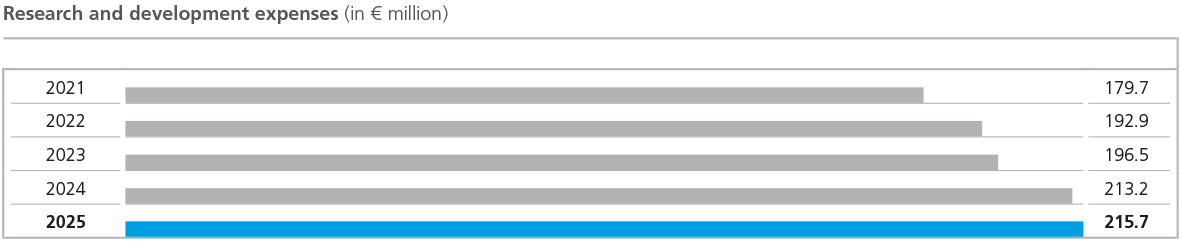
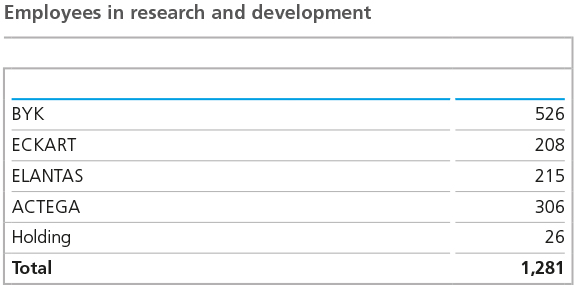
Our innovative strength is based on an open and dynamic corporate culture that gives our 1,281 employees in research and development centers worldwide the freedom for creative and entrepreneurial action. The equipment in our development centers enables our employees to transform ideas into market-ready solutions. Research and development expenses increased by € 2.5 million year on year to € 215.7 million (previous year: € 213.2 million). The share of sales accounted for by research and development expenditure rose to 7.0 % (previous year: 6.7 %), mainly due to the nominal decline in sales compared with the previous year. In general, our R&D expenditure is linked to the achievement of key milestones, the implementation of individual customer requirements in future innovative products, and the long-term orientation of our innovation activities.
Employees
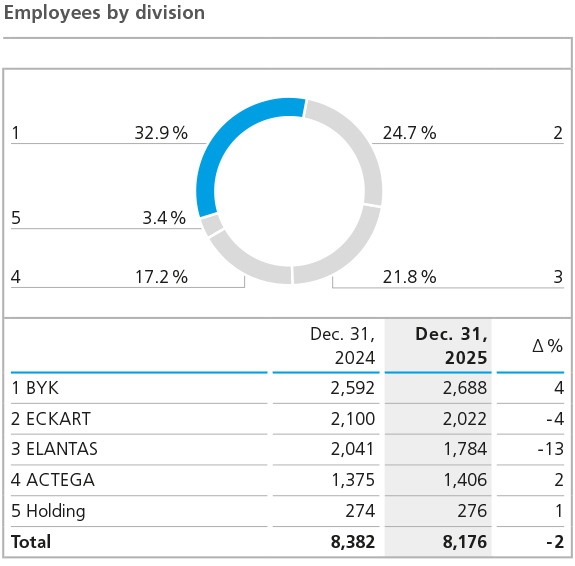
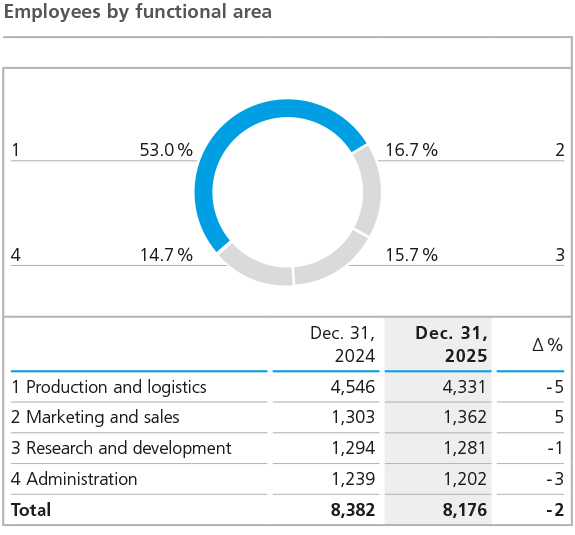
At the end of 2025, the companies in the ALTANA Group employed 8,176 people worldwide (previous year: 8,382). The decrease of 206 employees, or 2 %, compared with the previous year is primarily attributable to the divestment of acquired business activities as part of the integration of the Von Roll and Silberline Group acquisitions completed in 2023 and 2024.
In the BYK division, the number of employees increased in 2025 by 96 to 2,688 (previous year: 2,592), mainly in marketing and sales and in production.
At ECKART, the headcount sank by 78 to 2,022 in the course of the year (previous year: 2,100). The decrease affected all functional areas and was largely due to integration measures following the acquisition of the Silberline Group in 2024.
In the ELANTAS division, the workforce decreased by 257 to 1,784 employees (previous year: 2,041). The divestment of business activities in battery protection, composite materials, and wire insulation resulted primarily in a reduction of employee numbers in production. In total, five companies of the Von Roll Group acquired in 2023 in Germany, the United Kingdom, and India were affected.
At ACTEGA, staff numbers increased by 31 to 1,406 (previous year: 1,375). While the workforce in production declined, research and development as well as marketing and sales recorded increases in the number of employees.
At the Group holding companies, the headcount rose slightly to 276 (previous year: 274).
The functional structure of the workforce changed only marginally in the 2025 fiscal year. The proportion of employees in production decreased to 53 % (4,331 employees; previous year: 4,546), of which 213 were attributable to the divestments in the ELANTAS division. The number of employees in research and development decreased in 2025 by 13 to 1,281 employees (previous year: 1,294). In marketing and sales, the headcount increased during 2025 by 59 to 1,362 employees (previous year: 1,303). Administration comprised 1,202 employees in the reporting year (previous year: 1,239), a decrease of 37 employees.
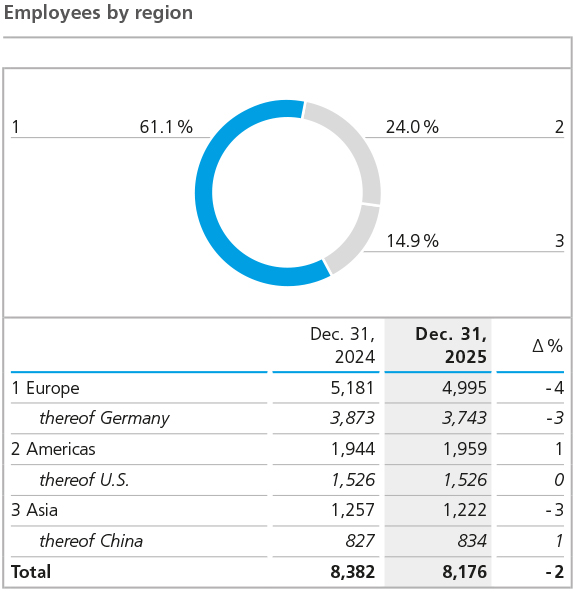
In terms of regional structure, there were slight shifts from Europe to the Americas in 2025 compared to the previous year, primarily due to the divestment of ELANTAS business activities in the context of the Von Roll integration. European Group companies continued to account for by far the largest share of the workforce. The number of employees declined by 186 to 4,995 (previous year: 5,181). At the end of the year, 3,743 employees (previous year: 3,873) were based in Germany, with the majority working at the largest production and development sites of the ECKART and BYK divisions in Hartenstein and Wesel, respectively. In the Americas, the number of employees increased by 15 to 1,959 at year-end 2025 (previous year: 1,944). The workforce in Asia decreased by 35 employees, from 1,257 in the previous year to 1,222 in 2025, mainly attributable to the sale of Von Roll India business activities.
At the end of the 2025 fiscal year, 2,171 women and 6,005 men worked at ALTANA. On the balance sheet date, 88 % of all employees had an unlimited contract and 12 % a limited contract. At the end of 2025, 76 % of female employees were employed full-time and 24 % part-time. Among male employees, the share of full-time employees was 97 %. Apart from the Group’s own employees, 158 people from employment agencies worked for Group companies as of December 31, 2025. The decrease compared to the previous year (- 295) is primarily attributable to the sale of Von Roll India.
In the year under review, the Human Resources department focused on the further development of a global corporate culture and on establishing supporting processes in line with ALTANA’s growth and increasing international presence.
One building block in promoting the global corporate culture is the “Expert Program,” which supports the further development of technical experts without direct managerial responsibility. In the year under review, the program was established internationally, with participant groups from Germany, Italy, China, and India. ALTANA employs many specialists who collaborate across disciplines in projects and initiatives. It is particularly important to provide these employees with the right tools in areas such as self-reflection, technical leadership, and conflict management to ensure the best possible success.
In addition, 37 participants successfully completed ALTANA’s international or Europe-wide management development programs in the reporting year. These programs provided comprehensive knowledge in areas including leadership, project management, and finance, preparing participants for more advanced responsibilities and fostering cross-divisional cooperation.
To safeguard the long-term success of the company through employee retention in times of skilled labor shortages and in line with ALTANA’s corporate values of appreciation and openness, the company strives to offer employees opportunities for career advancement. The internal recruiting process is intended to highlight development perspectives and to identify individuals within the organization who are willing and able to take on new challenges. In the reporting year, the internal recruiting guideline was adopted to support this initiative. It represents an important building block for the project to introduce the SAP Success Factors recruiting module across ALTANA companies, which is scheduled for completion in 2026.
Environment and Safety
Environmentally responsible business practices and occupational safety are key components of ALTANA’s corporate strategy. The ALTANA Group measures progress in environmental protection using specific key performance indicators, particularly greenhouse gas emissions in Scope 1 and Scope 2 (Scope 2 calculated using the market-based method), while safety performance is assessed using accident indicators.
Safety has the highest priority at ALTANA. Our goal is to continuously reduce the number of accidents and ideally stabilize it at a level close to zero. Through technical and organizational measures tailored to site-specific production conditions and applicable laws and regulations, the ALTANA Group ensures continuous improvement in occupational safety. All sites have established their own safety organizations responsible for compliance with local occupational safety regulations, training, and accident reporting and evaluation.
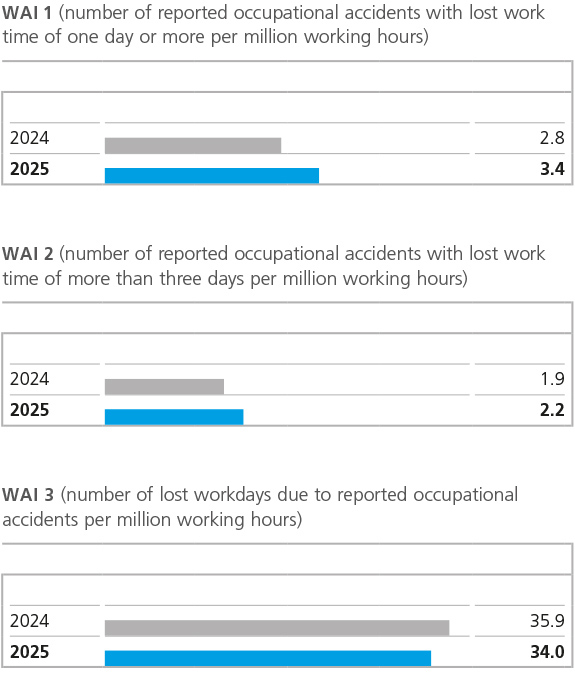
Throughout the Group, the Work Accident Indicator (WAI) serves as the key performance indicator for recording and evaluating the development of occupational safety at all sites based on reported accidents with lost work time. Three key figures are defined for better comparability: WAI 1 refers to the number of reported occupational accidents with lost work time of one day or more per million working hours. WAI 2 comprises the number of reported occupational accidents with lost work time of more than three days per million working hours. WAI 3 represents the number of lost workdays due to reported occupational accidents per million working hours, whereby a maximum of 30 days per accident is taken into account.
ALTANA determines the working hours on the basis of the actual hours worked. If such recording is not possible, a qualified estimate of the average hours worked is made. Accidents are recorded directly on site and reported to a defined group of persons within 48 hours. On a quarterly basis, the reported accidents with lost workdays are evaluated in a global IT system. Subsequently, the evaluations are made available to all responsible persons, such as the Management Board, division presidents, managing directors, and experts from the area of Sustainability & EHSR. Based on this data, ALTANA’s Management Board, together with the Sustainability & EHSR department, sets target values for the three WAIs for each year, which apply equally to all ALTANA Group companies.
For 2025, ALTANA again defined ambitious target ranges for all three accident indicators (WAI 1: 0 to 2.8; WAI 2: 0 to 1.9; and WAI 3: 0 to 35.0), thereby once again underlining the importance of continuously improving occupational safety within the company. In addition, ALTANA defined target ranges excluding the Von Roll Group and the Silberline Group, as these contributed different levels of maturity in their safety culture. Excluding the Von Roll Group and the Silberline Group, the following target ranges were agreed: WAI 1: 0 to 2.2; WAI 2: 0 to 1.5; and WAI 3: 0 to 27.0.
The target ranges for WAI 1 and WAI 2 were not achieved either including or excluding the acquisitions. A total of 48 occupational accidents with lost workdays were reported worldwide at ALTANA. Based on hours worked, WAI 1 was 3.4 (previous year: 2.8), WAI 2 was 2.2 (previous year: 1.9), and WAI 3 was 34.0 (previous year: 35.9). Excluding the Von Roll Group and the Silberline Group, the WAI figures were as follows: WAI 1: 3.5 (previous year: 1.9); WAI 2: 2.1 (previous year: 1.1); and WAI 3: 31.2 (previous year: 21.5).
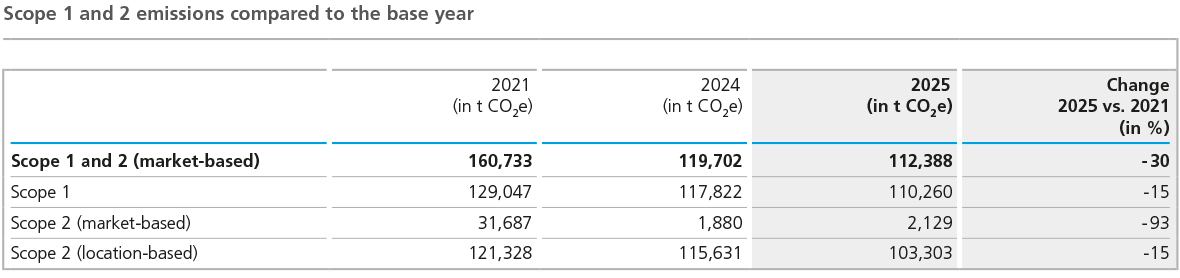
In alignment with the Science Based Targets initiative (SBTi), ALTANA has defined both short- and long-term emission reduction targets. By 2032, Scope 1 and 2 emissions are to be reduced by 50 % compared with the base year 2021. By 2040, 90 % of Scope 1 and 2 emissions within ALTANA’s direct sphere of influence are to be reduced (Scope 2 calculated using the market-based method). To monitor progress, ALTANA reports annually not only its Scope 1 and 2 emissions but also the interim targets required under the SBTi pathway to remain within a greenhouse gas budget compatible with the Paris climate goals.
ALTANA’s efforts to achieve this goal focus primarily on increasing energy efficiency and electrifying processes and vehicles. To improve energy efficiency, the company sets annual reduction targets for total energy consumption relative to produced finished goods. To realize increasing electrification, the Group’s investment management guideline includes an internal CO² price. With the global procurement of green electricity since 2020, an initial milestone on the path to independence from fossil energy sources has been reached. For the electricity purchased, ALTANA acquires an equivalent amount of guarantees of origin in accordance with recognized quality standards, such as Certificate of Origin (CoO) for Europe, Green-e® for the United States, and International Renewable Energy Certificate (IREC) for China, primarily through local green electricity contracts. This electricity is generated from renewable energy sources, and its origin is transparently verified through guarantees of origin.
In addition to focusing on reducing emissions within its own value chain, ALTANA invests in certified climate protection projects. When selecting projects, the company ensures that they are certified according to internationally recognized standards, such as the Verified Carbon Standard (VCS), and that they contribute to selected United Nations Sustainable Development Goals. The internal project portfolio is reviewed annually to ensure that it continues to meet ALTANA’s requirements. This voluntary contribution to mitigating climate change is not offset against emissions generated within the Group. The approach is, however, consistent with the SBTi’s recommended best practices for support measures on the path to defossilization.
ALTANA uses a Group-wide reporting system, established in accordance with the Greenhouse Gas Protocol, to quantitatively record the key performance indicators for Scope 1 and Scope 2 greenhouse gas emissions. The nonfinancial scope of consolidation corresponds fully to the financial scope of consolidation. Within this scope, the operational control approach is applied to record emissions at asset level.
On this basis, ALTANA has expanded its reporting system in recent years to include the recording of indirect emissions along the value chain (Scope 3). In 2025, for the first time, Scope 3 emissions for the 2021 and 2024 fiscal years were audited with limited assurance. The Scope 3 emissions for the 2025 fiscal year, also audited with limited assurance, are presented in detail in the document “Facts and Figures on Sustainability.”
Scope 1 and 2 emissions are calculated based on activity data, in particular energy consumption, and corresponding emission factors. Energy consumption is generally determined from utility bills. If billing data for the final two months of the reporting year is unavailable, companies provide a qualified estimate. Accordingly, prior-year values may be retrospectively adjusted once complete billing data becomes available.
Energy consumption at all production sites within the scope of consolidation is recorded in a global reporting system and multiplied by the relevant emission factors. For Scope 1 energy sources, emission factors from the IPCC (Intergovernmental Panel on Climate Change) are applied. CO² equivalents for Scope 2 are calculated using the factors published by the International Energy Agency (IEA) for the location-based method (2023 values) and using electricity supplier or product-specific emission factors for the market-based method.
For the specific energy indicator, based on one metric ton of finished goods, ALTANA set a target value of 1.44 MWh / t for 2025. For greenhouse gas emissions, a target of 131.3 thousand metric tons of CO² equivalents was set within the SBTi target range.
In 2025, ALTANA reported total energy consumption of 824,991 MWh (previous year: 871,320 MWh). Around 90 % of this consumption was attributable to the two main energy sources: natural gas (438,594 MWh) and electricity (306,822 MWh). For purchased electricity, an equivalent number of certificates of origin was acquired in accordance with recognized quality standards, primarily through local green electricity contracts. Due to contractual arrangements, ALTANA plans to finalize the retirement of the majority of certificates for 2025 in April 2026.
ALTANA achieved its target for the specific energy indicator, reporting 1.41 MWh / t (previous year: 1.50 MWh / t). The significant reduction in energy consumption at a stable production level is primarily due to site consolidations.
The resulting greenhouse gas emissions are presented in the following table. The table also compares Scope 1 and 2 emissions to the base year. As the table shows, the annual interim targets for Scope 1 and 2 were met in 2025, confirming the effectiveness of the measures and projects implemented under the Group’s climate strategy.
Outside its own value chain, ALTANA offset 113,020 metric tons of CO² equivalents in the reporting period through certificates in India. In 2025, this voluntary compensation exceeded the emissions generated in Scope 1 and 2.
The certificates relate to the “Kinnaur Hydroelectric Power Plant” project on the Satluj River in Himachal Pradesh (Verra Register VCU serial number 9355-83857819-83961118-VCS-VCU-997-VER-IN-1-1742-01012018-31122018-0) and the “Saipuram Wind Farm” project in Andhra Pradesh (Verra Register VCU serial number 10929-257142350-257217349-VCS-VCU-997-VER-IN-1-1788-01012020-31122020-0).